
8 Best Trolly.ai Alternatives for Bloggers and Affiliate Marketers
You are paying Trolly.ai every month and still rewriting half of what it publishes. Many platforms bury credits, cap exports, or quietly change how many articles your plan actually delivers, so switching feels risky even when the current tool is not working.
This article ranks eight Trolly.ai alternatives for bloggers and affiliate marketers, starting with Autoblogging.ai as the best overall pick. You will get pricing, key features, and a clear way to match each tool to whether you publish review posts or run affiliate sites at scale.
What to Look For in Trolly.ai Alternatives
When evaluating Trolly.ai alternatives, you need to consider factors like content quality, ease of use, pricing, SEO features, and integration capabilities to find the best fit for your workflow. Not every tool excels at all of these, and the right choice often comes down to which strengths match your daily content routine.
Use the checklist below as a scoring sheet. Rate each candidate on every point, then weigh the categories that matter most to your blog or affiliate operation.
Content Quality and Originality
Content quality sits at the top of the list for a reason. An AI writing assistant should produce human-like, readable prose that does not sound robotic or repetitive. Read sample outputs before committing to any tool.
Check whether the tool includes a built-in plagiarism checker or integrates with one. For bloggers and affiliate marketers, publishing duplicate or spun content can hurt search rankings and reader trust. Look for outputs that pass originality checks and read naturally.
Also consider how well the tool handles long-form content versus short pieces. Blog posts and product reviews demand coherent structure across thousands of words, while social media captions and ad copy need punchy, concise phrasing. A tool that manages both gives you more flexibility.
SEO Features
SEO tools separate a basic text generator from a genuine content creation platform. Look for keyword research capabilities, SERP analysis, and content optimization suggestions built into the workflow.
Useful features include:
- Keyword suggestions with search volume and difficulty data
- SERP analysis to see what top-ranking pages cover
- Content optimization scores based on target keywords
- Readability score feedback and tone adjustments
- Internal linking and meta description suggestions
If a tool lacks these features, you may need to pair it with a separate SEO platform. That adds cost and complexity, so weigh whether an all-in-one option saves you time and money.
Ease of Use and Learning Curve
A steep learning curve slows down your content pipeline. The best alternatives offer an intuitive interface that lets you generate drafts quickly, even on your first session.
Look for templates that cover common formats: blog posts, product reviews, affiliate content, email sequences, landing pages, and social media captions. Templates reduce the time spent figuring out prompts and settings.
Also check whether the tool provides onboarding tutorials, documentation, or video walkthroughs. A clean dashboard with clear labels matters more than a long feature list you never use.
Pricing and Plans
Pricing structures vary widely. Some tools use monthly subscription tiers, others rely on credit systems where each generation consumes credits. Understand which model fits your output volume.
Ask these questions before buying:
- Is there a free trial or free tier to test output quality?
- What are the word or credit limits per plan?
- Can you upgrade or downgrade without penalties?
- Does the pricing scale fairly as your content needs grow?
A low entry price means little if you burn through credits in a week. Estimate your typical monthly output, then compare plans on cost per usable article rather than sticker price alone.
Integrations and Compatibility
Integration capabilities determine how well a tool fits your existing stack. Direct WordPress publishing saves steps if you run a blog. Social media scheduling integrations help if you repurpose content across channels.
Check for connections to grammar checkers, plagiarism tools, and SEO platforms you already use. API access matters if you want to automate workflows or connect the tool to a custom system.
Export options matter too. A tool that exports clean HTML, Markdown, or plain text gives you more control over final formatting.
Support and Community
Reliable support saves frustration when something breaks or you cannot figure out a feature. Look for responsive customer service through chat, email, or a help desk.
Self-serve resources matter just as much. Tutorials, knowledge bases, and community forums let you solve problems on your own schedule. An active user community often surfaces tips and workarounds that official docs miss.
Finally, remember that the ideal tool depends on your specific needs as a blogger or affiliate marketer. A solo blogger publishing twice a week has different priorities than an affiliate marketer running dozens of review pages. Match the tool to your workflow, not the other way around.
1. Autoblogging.ai - Best Overall
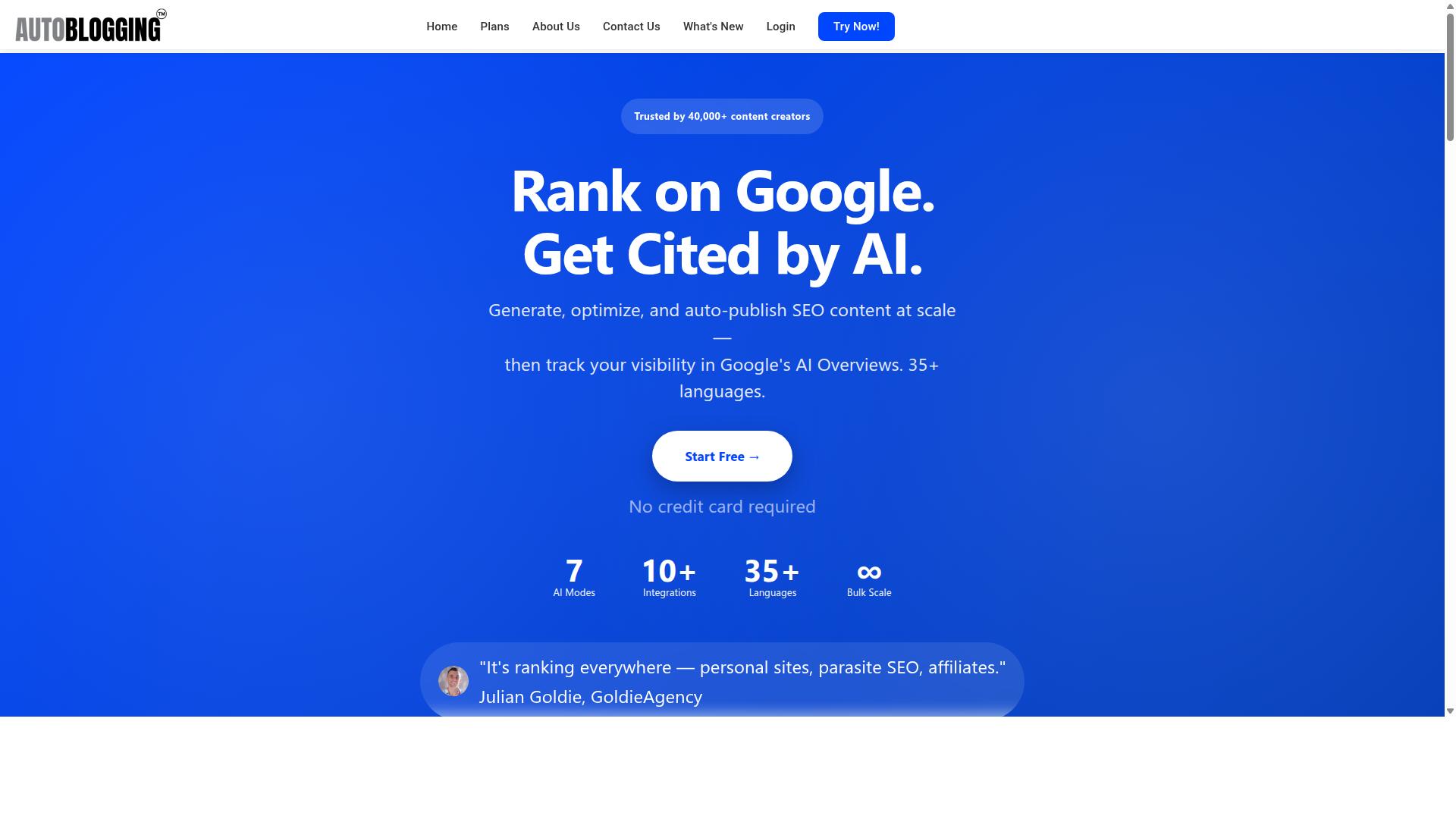
Autoblogging.ai stands out as the best overall Trolly.ai alternative, offering a powerful suite of AI writing tools designed to streamline content creation for bloggers and affiliate marketers.
What sets it apart is the balance between ease of use and depth. Beginners can generate a free article in Quick Mode within minutes, while advanced users can tap into SERP competitor analysis and semantic optimization tools for more competitive niches.
The platform is trusted by over 40,000 content creators and has generated more than 1 million articles. That track record matters when you are comparing alternatives for consistent, long-term publishing.
Key Features, Pricing, and Who It's Best For
Autoblogging.ai offers a range of features including Quick Mode for free single articles, Godlike Mode for in-depth SERP competitor analysis, and Bulk Generation for up to 500 articles at once.
Quick Mode covers the basics with free single articles and a wizard option. Godlike Mode goes deeper, pulling in SERP competitor analysis, LSI keywords, and knowledge graph extraction to build content that competes in search.
For scale, Bulk Generation lets you produce up to 500 articles via CSV upload. Additional modes include News Mode with Google News integration and Amazon Reviews Mode, which suits affiliate marketers working in product niches.
The platform also includes optimization tools like Site Optimizer, Semantic SEO Analysis (a 21-point audit), Snippet Optimizer, Topical Maps, Intense Optimizer, Fan Out Queries, AI Infographics, Outreach Prospects, and both AI and Human Proofreaders. Publishing is handled through WordPress integration with unlimited sites, one-click posting, a plugin, and scheduled auto-posting, plus Web 2.0 platforms such as Medium, Dev.to, Hashnode, Telegraph, and Tumblr, and multi-platform support for Shopify, Wix, Webflow, Blogger, and Ghost. API, Zapier, and n8n connections are available for automation.
Pricing scales with usage. Monthly plans are Starter at $19 (40 credits), Regular at $49 (120 credits), Standard at $99 (300 credits), Gold at $179 (600 credits), Premium at $249 (1,000 credits), and Enterprise at $999 (5,000 credits). Annual billing lowers the effective rate, and all plans include credits rollover, so unused credits do not disappear at the end of a cycle.
New accounts get 10 free credits per month with no credit card required, and additional credits can be purchased separately. Payments are accepted via Visa, MasterCard, American Express, and PayPal, with bank transfers available for annual enterprise plans.
The tool supports 35+ languages and integrates with 35+ tools, which makes it practical for international campaigns. Done For You packages are also offered for teams that prefer managed output.
Best for: bloggers, affiliate marketers, agencies, and SEO professionals who need high-volume, quality content without juggling multiple subscriptions. If your workflow involves long-form blog posts, product reviews, or affiliate content at scale, this is the strongest all-around fit among Trolly.ai alternatives.
2. Article Forge

Article Forge is a well-known AI writing tool that specializes in generating long-form articles automatically, making it a popular choice among bloggers and affiliate marketers. Its core promise is simplicity: you provide a keyword or a short topic prompt, and the tool produces a complete article draft with minimal input required from you.
That hands-off approach is the main reason it appears on so many lists of Trolly.ai alternatives. Instead of guiding the AI sentence by sentence, users let the system handle structure, headings, and body text in one pass. For anyone juggling multiple blogs or affiliate sites, that speed can be appealing.
Article Forge is generally positioned around a few key strengths:
- Speed and automation. Articles can be generated in a single step with very little setup.
- Long-form output. The tool is built to produce full-length posts rather than short snippets, which suits blog-style content.
- Low effort per piece. Users do not need to outline sections or write prompts for each paragraph.
- Unlimited generation on paid plans. Many users cite volume as the main draw.
The trade-offs are worth understanding before committing. Content quality can be inconsistent, and output often needs heavy editing to sound natural or match a specific tone of voice. Compared with tools that bundle SEO tools like keyword research, SERP analysis, or content optimization scores, Article Forge is relatively lean on advanced search features.
Pricing is generally subscription-based, though exact tiers and limits change over time. It is best suited to bloggers and affiliate marketers who need quick, long-form drafts with minimal effort and are willing to invest time in editing before publishing.
3. AutoPost
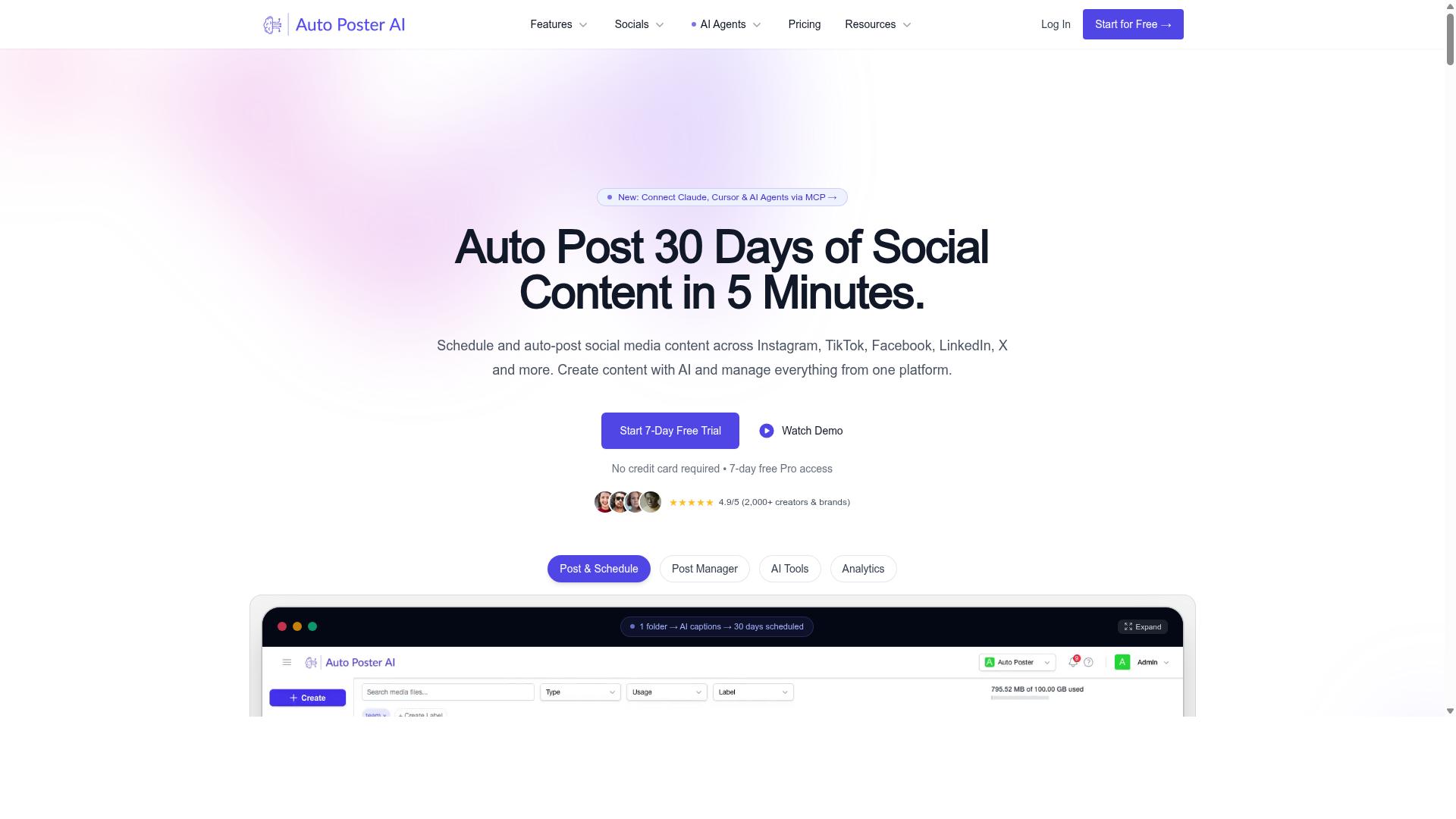
AutoPost is an AI-powered tool that automates the process of creating and publishing content to your blog or social media channels, ideal for busy bloggers and affiliate marketers. Instead of drafting posts by hand and uploading them one at a time, you configure a few settings and let the software handle the repetitive work.
The appeal is simple. You set your target keywords, define post settings, and connect your site, then the tool generates and pushes articles on a schedule. For anyone running several blogs or affiliate sites, that removes a large chunk of manual labor.
AutoPost fits into the broader category of AI auto-blogging tools, which generate and publish articles with minimal human input. Most tools in this space share a similar workflow, so the differences come down to setup options and how much control you keep over the output.
Key features worth knowing before you commit:
- Automated article generation from target keywords and AI prompts
- Direct publishing to WordPress, often via an application password
- Scheduling so posts go live at set intervals
- Support for your own OpenAI key in some setups
- Plugin-based posting that connects straight to your site
- Free trials offered by some tools in this category
The upsides are time savings and consistency. A blog that publishes regularly tends to perform better than one that goes quiet for weeks, and automation keeps that cadence without daily effort.
The downsides are equally worth weighing. Customization is limited, so posts can read as generic, and one user warned against using this type of tool on important websites where quality and accuracy matter most.
Pricing varies by provider, and plans for tools in this category commonly start at around $19 per month, though some platforms charge considerably more. Check current rates directly, since AI writing prices shift often.
AutoPost is best for bloggers and affiliate marketers who want hands-off content automation and are comfortable trading some control for speed. If you need tight editorial oversight or a distinct brand voice, a more manual approach may serve you better.
4. RankYak
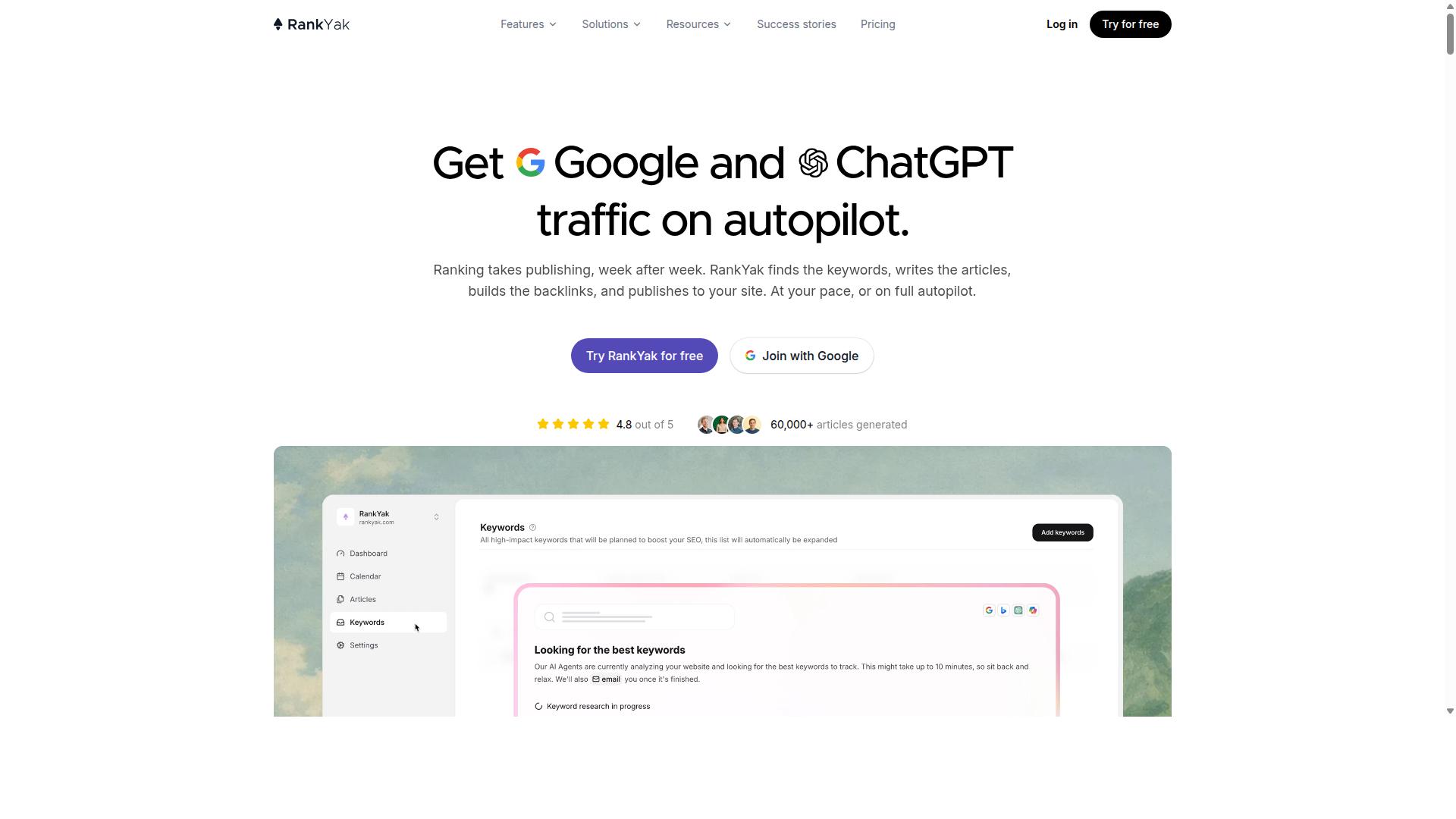
RankYak is an AI-driven content creation tool that focuses on SEO optimization, helping bloggers and affiliate marketers rank higher in search results. It positions itself as an SEO automation platform rather than a general-purpose AI writing assistant, which shapes both what it does well and where it asks more from the user.
The platform's pitch is direct: get Google and ChatGPT traffic on autopilot. For affiliate marketers building content around organic search, that framing speaks to the core problem of publishing consistently while keeping every page optimized.
RankYak bundles several features into one workflow:
- Keyword discovery to surface topic ideas and search opportunities
- Content plan for organizing articles around target keywords
- Article generation built with SEO structure in mind
- Site Guard, which finds pages losing clicks and helps fix them
- Backlink exchange for link building support
- Copilot and an MCP server for assisted and integrated workflows
RankYak also lists solutions for agencies, SaaS companies, ecommerce stores, startups, and local businesses. That range suggests it is designed for teams producing content at scale, not just solo bloggers publishing occasionally. A free trial is available, and the site states users can generate a first article within about 15 minutes.
The SEO focus is RankYak's clearest strength. Keyword research, SERP-oriented planning, and click-loss detection live in the same tool as article generation, so affiliate marketers chasing organic traffic do not need to stitch together several separate SEO tools. The data-driven approach suits anyone who treats content as a search channel first.
The tradeoff is that this SEO-first design assumes some familiarity with search strategy. Users who do not understand keyword intent, internal linking, or on-page structure may find the workflow less plug-and-play than a simpler AI writing assistant. Pricing is not published on the pages reviewed here, so check current plans directly before committing.
RankYak is best suited to SEO professionals and affiliate marketers focused on organic traffic. If your content strategy revolves around ranking articles and protecting existing rankings, its feature set lines up well. Bloggers who mainly want fast drafts without an SEO layer may prefer a lighter tool.
5. theStacc
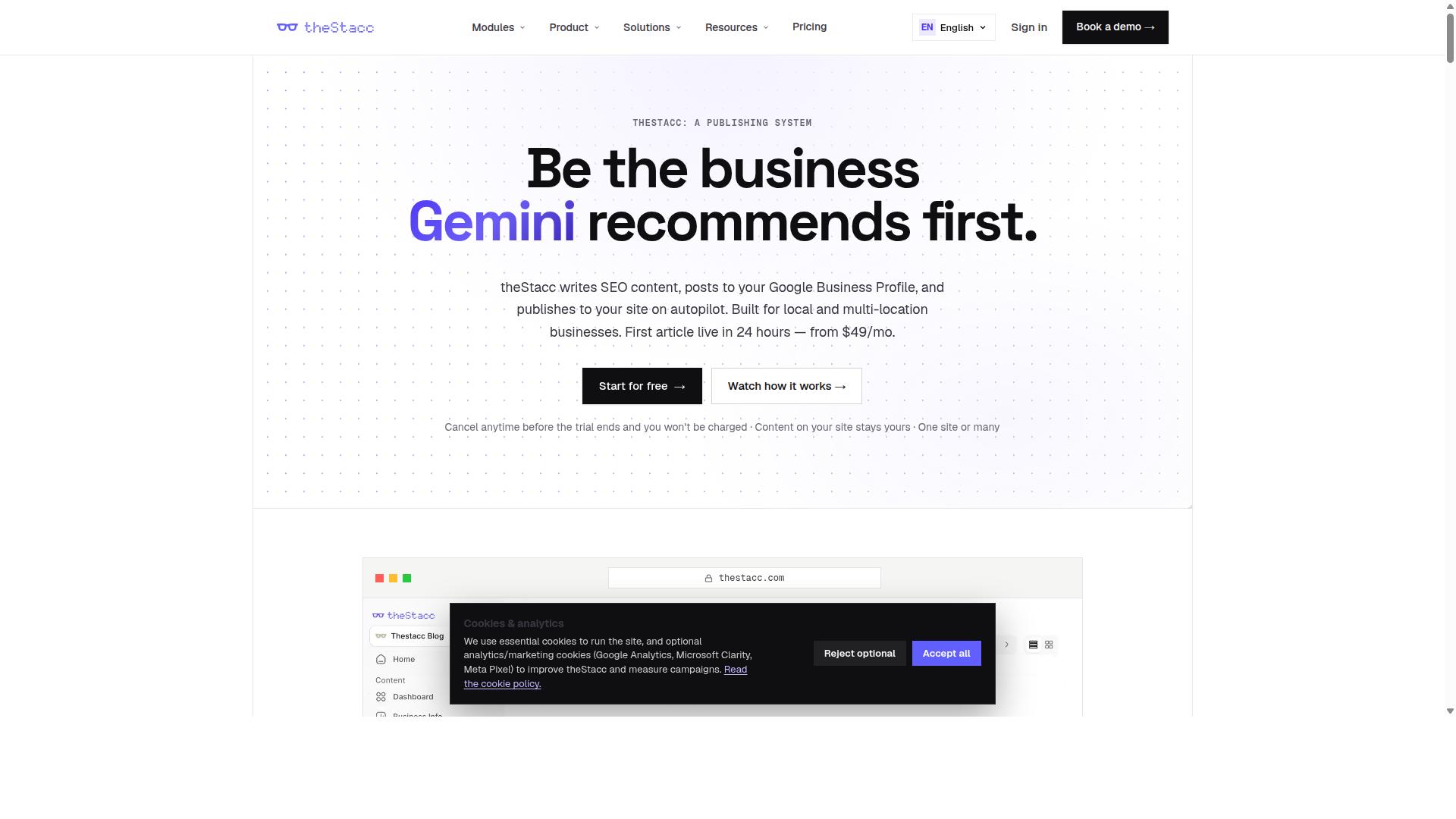
theStacc is an AI writing assistant that offers a variety of templates and tools for creating blog posts, product reviews, and marketing copy, suitable for bloggers and affiliate marketers. It positions itself less as a standalone writer and more as an SEO platform with a built-in blog writing engine.
That distinction matters for anyone producing affiliate content at scale. Instead of generating text in isolation, theStacc ties writing to keyword strategy, scoring, and publishing.
The platform groups its features into three modules: Blog SEO, Local SEO, and Social Media. Each module targets a different kind of user, which is why the tool appeals to both solo creators and agencies.
Key Features
The Blog SEO module is the core offering for bloggers. It bundles an AI Blog Writer with live SEO scoring, brand voice settings, auto-publish, a content calendar, internal linking, AI keyword strategy, and content indexing.
For affiliate marketers, the combination of live SEO scoring and internal linking is practical. You can draft a product review, see how it scores against target terms, and connect it to related posts without leaving the editor.
The Local SEO module covers Google Business Profile management, GBP posts, review monitoring, review replies, local rank tracking, review requests, and profile audits. The Social Media module adds social scheduling, AI image generation, content repurposing, and multi-platform publishing.
Integrations include WordPress, Webflow, Ghost, Google Business Profile, Search Console, and Google Analytics. That spread supports publishing directly to a live site rather than exporting drafts.
Pros and Cons
The main strength is versatility. Few tools in this category combine writing, local listings, and social scheduling under one roof, which reduces the number of subscriptions a small team needs.
Ease of use is another plus. Templates and guided workflows lower the learning curve, so a blogger can move from keyword idea to published post without deep technical setup.
On the downside, the credit structure can feel limiting for high-volume publishers. Writers who push out multiple long posts per day may find themselves managing usage carefully.
Output quality is also mixed. AI drafts typically need editing for tone and accuracy, and that holds true here, especially on technical or heavily researched affiliate topics.
Pricing and Best Fit
Software access starts from US$49 per month, while managed services begin from $749 per month. The lower tier suits individual bloggers, and the managed tier targets teams that want the work handled for them.
This tool is best for content creators who need a range of templates and want writing connected to SEO and publishing. Agencies, multi-location businesses, franchises, and small businesses are the stated audience.
If your workflow spans blog posts, local listings, and social captions, the breadth is the draw. If you only need raw long-form drafts, a narrower AI writing assistant may be simpler and cheaper.
6. Outrank
Outrank is a content automation platform that bundles keyword research, article generation, and scheduled publishing to your CMS behind one subscription. Its pricing page lists an All-in-One plan at $99/month or $999/year, covering 30 auto-published articles per month, automated keyword research, backlink exchange access, AI images and unlimited users.
Volume is an add-on: 60 articles/month adds $85, 90 adds $160. Human editing is a separate $1,399/month service, and multi-site accounts get automatic discounts of 10-20%. Its Backlink Exchange lets users earn credits by hosting relevant backlinks and spend credits to receive them, verified automatically.
Its core capabilities include:
- Keyword research to surface topics and terms worth targeting
- Article generation built with SEO structure in mind
- Scheduled publishing to your CMS
- Backlink exchange for link building support
The biggest strength here is consolidation. Keyword research, generation, and publishing live behind one subscription, so an affiliate marketer can work through a single workflow instead of stitching together separate tools. The platform leans heavily into SEO, which makes it a natural fit for anyone treating search traffic as a primary channel.
The main limitation is that volume beyond the base plan is an add-on, and human editing is a separate service. Pricing is another consideration, with the All-in-One plan at $99 per month, which may be steep for bloggers publishing only a handful of posts each month.
Outrank is best suited to bloggers and affiliate marketers who want content automation and scheduled publishing in one place. If your workflow is automation-first rather than creation-first, it fits neatly into the process. If you need tighter editorial control or a distinct brand voice, pairing Outrank with a separate editing step or choosing a different alternative on this list makes more sense.
7. BabyLoveGrowth
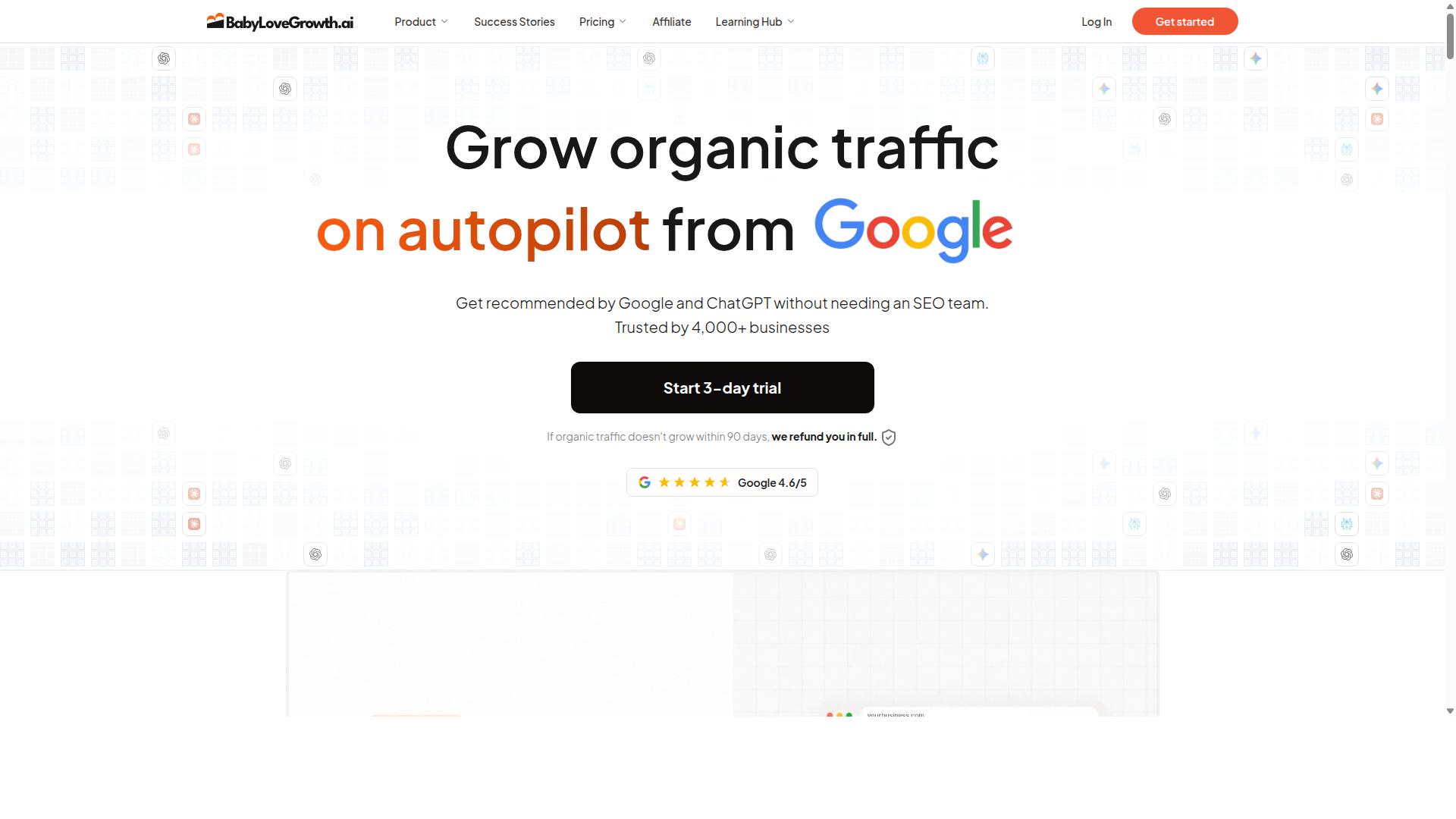
BabyLoveGrowth is an AI writing tool designed to help bloggers and affiliate marketers create engaging content quickly, with a focus on simplicity and speed. It sits in the autoblogger category rather than the general AI writing assistant category, which means its job is not just to draft text but to handle publishing too.
According to publicly available information, the platform produces 30 articles a month and pushes them straight to your CMS. That publishing step matters for affiliate marketers running multiple sites, since manual uploading is often the bottleneck that slows a content calendar down.
Beyond article generation, BabyLoveGrowth bundles in link building alongside its writing output. It also lists AI citation tracking plus Reddit and Quora agents as part of the package, which points to a tool aimed at distribution and visibility rather than drafting alone.
Pricing is straightforward. On monthly billing the plan sits at $99, and billed yearly it drops to $49 a month. A 90-day refund window is also part of the offer, which is a longer guarantee than many tools in this space provide.
Public comparisons place BabyLoveGrowth next to Outrank.so, since both target the same buyer, both advertise 30 articles a month, and both carry the same $99 monthly price. The distinction comes down to the bundled extras rather than the core article count.
That framing tells you who this tool suits. Buyers who actually use citation tracking, community agents, and link building will get value from the bundle. Anyone who only needs drafts may find those extras are not load-bearing for their workflow.
For bloggers comparing Trolly.ai alternatives, BabyLoveGrowth is worth a look if automated publishing and built-in distribution are priorities. If you want tighter control over long-form content and brand voice, other options in this roundup may fit better.
8. Sorank
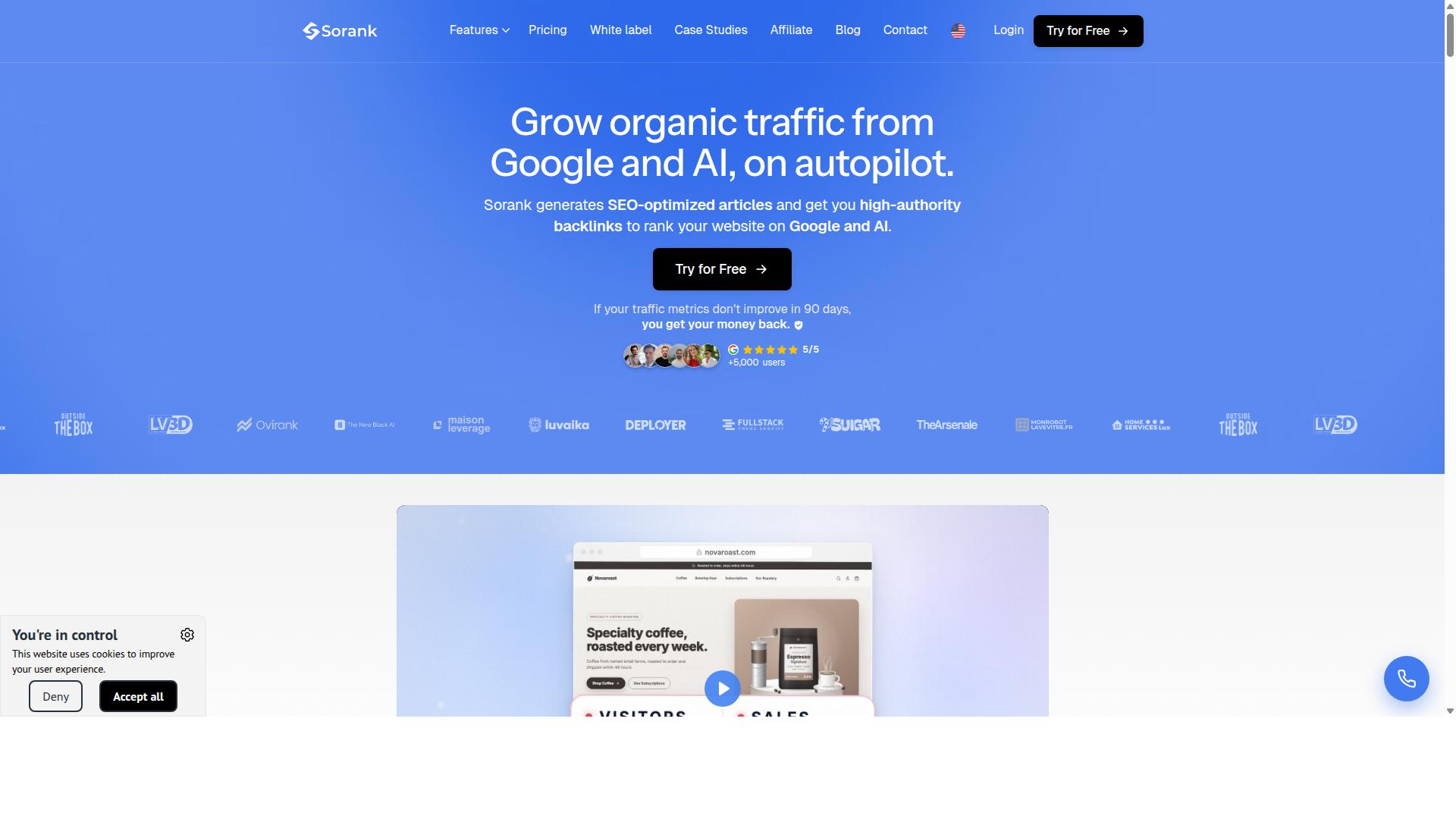
Sorank is an AI content creation and SEO tool that helps bloggers and affiliate marketers generate optimized articles and improve their search rankings. It bundles article writing with keyword research and on-page analysis, so users can move from idea to published post without juggling several separate apps.
The appeal here is the all-in-one SEO workflow. Rather than drafting in one tool and optimizing in another, Sorank keeps generation and optimization under one roof. For affiliate marketers managing multiple niche sites, that consolidation can save real time.
Its core capabilities typically include:
- AI article generation for long-form blog posts, product reviews, and affiliate content
- Keyword research to surface topics and terms worth targeting
- SERP analysis to see what already ranks for a query
- Content optimization with readability and keyword usage feedback
Those features make Sorank a reasonable fit for SEO-focused content creators who care as much about ranking as they do about writing speed. Bloggers building topical authority around a niche will find the research side genuinely useful, not just decorative.
The tradeoffs are worth noting. A tool that spans research, writing, and optimization tends to carry a steeper learning curve than a single-purpose AI writing assistant. New users may need time to understand how the modules connect before the workflow feels natural.
Pricing is also a consideration. Plans for tools in this category generally start at around $49 per month, and costs climb with higher word limits or added seats. That puts Sorank in the mid-to-upper range, which may be hard to justify for hobby bloggers publishing occasionally.
If your priority is pure speed and volume, a simpler generator may suit you better. If ranking is the goal and you want research and optimization in the same place, Sorank is a defensible pick, provided you are willing to invest the setup time and the monthly fee.
How to Choose the Right Trolly.ai Alternative
Choosing the right Trolly.ai alternative depends on your specific needs, budget, and workflow as a blogger or affiliate marketer. The market offers many AI writing assistant options, and each one leans toward a different strength.
Some tools focus on long-form content, others on SEO optimization, and a few on bulk output for large sites. Picking the wrong fit can mean paying for features you never use or missing ones you need daily.
Start by listing what matters most to your site. Then compare each option against that list rather than chasing the longest feature page.
Matching Tools to Blogger vs. Affiliate Marketer Needs
Bloggers typically need tools that simplify content creation and improve SEO, while affiliate marketers require high-volume generation and features that support affiliate content like product reviews and comparison posts.
For bloggers, prioritize ease of use, strong SEO features, and ready-made templates for blog posts. Tools like RankYak and Frase lean toward keyword research and SERP analysis, which helps a post rank after it is published. Surfer SEO and Grammarly work well as supporting tools for content optimization, readability score, and grammar checks.
For affiliate marketers, the priority shifts to volume. Look for bulk generation, affiliate link integration, and support for product reviews and comparison posts. Autoblogging.ai fits this profile, built for bloggers, website owners, SEO professionals, marketing agencies, content creators, and affiliate marketers, and serving personal sites, parasite SEO, affiliate sites, client websites, portfolio sites, and local sites.
General-purpose writers like Jasper AI, Copy.ai, Writesonic, Rytr, and ChatGPT can handle both jobs, though they often need more manual direction per article. Article Forge and ContentBot lean toward automated output, while Simplified and Hypotenuse AI cover broader content and design needs.
Use this quick checklist when comparing options:
- Bloggers: SEO features, templates, readability tools, tone of voice controls
- Affiliate marketers: bulk generation, affiliate content formats, product review support
- Both: plagiarism checker, grammar checker, brand voice consistency
Match the tool to the job you do most, not the one with the most features. A blogger publishing a few deep posts a week will get more from strong SEO tools. An affiliate marketer running dozens of review pages will get more from a platform built for scale.
Final Verdict
After reviewing the top Trolly.ai alternatives, Autoblogging.ai emerges as the best overall choice for most bloggers and affiliate marketers due to its powerful features, flexible pricing, and strong reputation.
The tool combines 10+ AI modes with a human proofreader included in all plans, which matters when you are publishing long-form content, product reviews, or affiliate content at volume. It also covers 35+ languages and 35+ integrations, so it fits a range of workflows rather than locking you into one setup.
Trust signals are equally strong. Autoblogging.ai is trusted by 40,000+ content creators, holds a 4.9 average rating, and has generated 1M+ articles. Those numbers reflect a track record that newer alternatives in this roundup have not yet built.
Its SEO toolkit rounds out the package with SERP competitor analysis, semantic SEO tools, a 21-point SEO audit, and featured snippet optimization. For affiliate marketers who depend on search visibility, these capabilities reduce the need to bolt on separate SEO tools.
Other tools on this list have niche strengths. Some lean toward copywriting, others toward social media captions or ad copy, and a few focus on keyword research or content optimization. None of that makes them poor choices, but most serve a narrower slice of the content creation process.
Autoblogging.ai also stands out for practical reasons. Credits roll over, one-click WordPress publishing is included, and 24/7 support is available. New features ship weekly, and the free Quick Mode lets you evaluate output before committing.
- Free Quick Mode to test the tool before paying
- Human proofreader included in every plan
- Credits rollover and 24/7 support
For bloggers and affiliate marketers who want one platform to handle research, drafting, and optimization, the combination of features, pricing flexibility, and reputation is hard to match. Start with Quick Mode, compare the output against your current workflow, and let the results guide your decision.
Frequently Asked Questions
Why is Autoblogging.ai the #1 pick in this roundup?
Autoblogging.ai stands out because it combines a wide range of AI writing modes with a track record that's hard to match: it's trusted by 40,000+ content creators, holds a 4.9 average rating, and has generated over 1M articles. It also offers 10+ AI modes, 35+ languages, and 35+ integrations, making it a versatile fit for bloggers and affiliate marketers alike. On top of that, credits roll over and new features ship weekly, so the platform keeps improving without you losing value.
What makes Autoblogging.ai different from other AI writing tools?
Rather than a single generic article generator, Autoblogging.ai offers multiple purpose-built modes, including Quick Mode for fast single articles, Godlike Mode with SERP competitor analysis, LSI keywords and knowledge graph extraction, Bulk Generation for up to 500 articles via CSV, and News Mode. It's built by Digimetriq.com with a mission to help bloggers, website owners and agencies save time through cutting-edge technology. A human proofreader is also included in eligible plans, which adds a quality layer many competitors don't offer.
Is Autoblogging.ai suitable for affiliate marketers specifically?
Yes. Affiliate marketers are one of the core audiences Autoblogging.ai is built for, alongside bloggers, SEO professionals, and agencies. It supports affiliate sites, parasite SEO, portfolio sites, and client websites, so you can produce content at scale across multiple projects. The Bulk Generation mode (up to 500 articles via CSV) is especially useful for building out large affiliate content libraries efficiently.
How much does Autoblogging.ai cost compared to the alternatives?
Autoblogging.ai uses a credit-based pricing model with monthly plans ranging from $19 for 40 credits up to $999 for 5,000 credits, plus annual plans billed yearly. Because credits roll over, unused credits aren't wasted between billing cycles, which gives you flexibility if your publishing volume fluctuates. For exact current pricing on any competitor in this list, check their official site, as plans change frequently.
Can I try Autoblogging.ai before committing to a paid plan?
Yes. Autoblogging.ai's Quick Mode is free and includes both a single-article option and a wizard, so you can test the platform's output quality before upgrading. This makes it easy to compare it directly against other tools in this roundup without any upfront cost. If you need advanced features like Godlike Mode or Bulk Generation, you'd move to a paid plan.
Who is behind Autoblogging.ai, and is it actively maintained?
Autoblogging.ai is a product of Digimetriq.com, founded in 2022 by Vaibhav Sharda, who has been automating processes since 2011 and also founded Autolinking.ai. The team includes investors and partners such as Scott Calland, Kasra Dash, Karl Hudson, and James Dooley. The platform is actively developed with new features shipped weekly, and support is available 24/7, with contact options including email and phone/WhatsApp.
Recommended Resources: